Motivation is the force that initiates, directs, and sustains behavior — it answers why does an organism do anything at all? The MCAT treats motivation as both a psychological construct (what internal states or external rewards push behavior) and a biological phenomenon (how the brain regulates drives like hunger or addiction). Master the underlying logic each theory uses, not just the names.
Priority labels: Must know = cold; Know the logic = mechanism not names; Passage-level = recognize, don't memorize; Optional = skippable.
Factors That Influence Motivation
Four broad factors can "turn on" behavior — instincts, arousal, biological drives, and psychological needs. These are the raw ingredients; the theories below are the recipes.
Instinct
Must knowAn instinct is an innate, fixed pattern of behavior triggered by specific stimuli — no learning required, shared across a species. Instinct theory (William James, William McDougall) was the first major motivation theory but was replaced because it was circular: labeling a behavior an "instinct" explained nothing mechanistically. Passage-level matters mainly as historical contrast to later, more mechanistic theories.
Quick check: A baby automatically turns its head toward a touch on the cheek (rooting reflex). Is this an instinct? Yes — innate, species-universal, no learning. Instinct theory would label it but couldn't explain why it exists.
Arousal
Must knowArousal is a general state of physiological/psychological activation — the "volume knob" on your nervous system. Both too little (asleep) and too much (panicking) impair performance; there is an optimal level for any task.
The Yerkes-Dodson Law describes an inverted-U relationship between arousal and performance: performance rises as arousal increases toward an optimum, then falls beyond it. Crucially, the optimum depends on task difficulty:
- Simple/well-learned tasks → optimum at higher arousal.
- Complex/novel tasks → optimum at lower arousal.
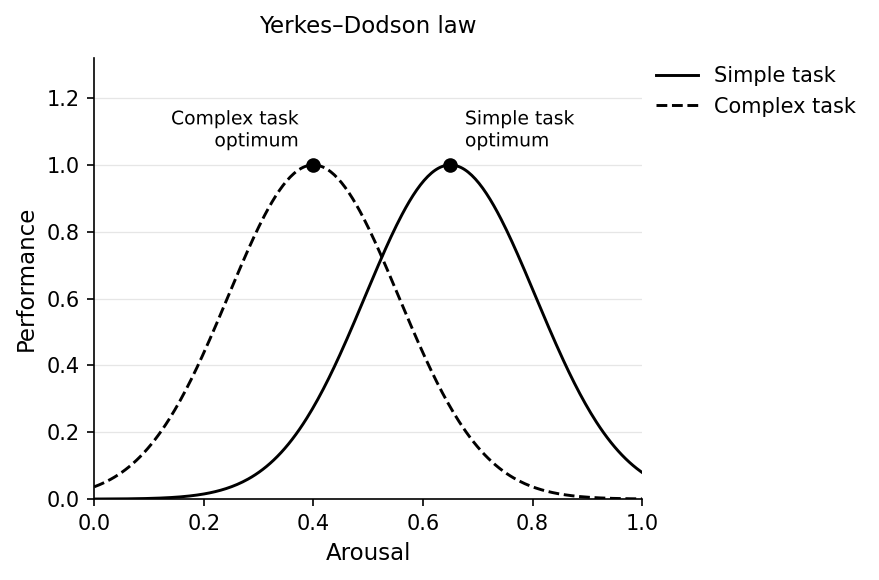
This connects to physiology: the sympathetic ("fight-or-flight") system is essentially arousal-increasing. Arousal theory proposes organisms seek to maintain an optimal (not zero) level of arousal — distinguishing it from drive reduction theory.
Quick check: A surgeon in a high-pressure emergency performs better than a bored one, but worse than one calmly focused. Where on the Yerkes-Dodson curve does each fall? Bored = left (too low); calmly focused = peak (optimal); overwhelmed = right (too high).
Drives and Negative-Feedback Systems
Must knowA drive is an internal state of tension created by a physiological need. A deficit (too little water/glucose) generates an aversive drive (thirst, hunger) that motivates corrective behavior; once corrected, the drive is reduced. This is a classic negative-feedback system: deviation from a set point triggers a corrective response that shuts off once the set point is restored (e.g., low blood glucose → hunger → eat → glucose rises → hunger off).
Know the logicHunger signaling (don't memorize the cascade):
- Ghrelin — stomach hormone, rises when empty, increases hunger ("ghrelin makes you growl").
- Leptin — adipose hormone proportional to fat stores, decreases hunger.
- Hypothalamus — master regulator: lateral (LH) = hunger center; ventromedial (VMH) = satiety center.
Quick check: A tumor destroys the ventromedial hypothalamus. Prediction? Loss of satiety → perpetual hunger and overeating (hyperphagia), weight gain.
Needs
Must knowNeeds are broader than drives, spanning physiological (food, water) and psychological (belonging, esteem, autonomy) requirements. A useful distinction: primary needs are biologically innate; secondary needs are learned. Needs lead into the need-based theories (Maslow, McClelland) below.
Theories That Explain How Motivation Affects Human Behavior
The MCAT tests whether you can apply each theory to a scenario, compare theories, and recognize their limitations.
Drive Reduction Theory
Must knowClark Hull's drive reduction theory formalizes the negative-feedback drive model: all motivated behavior aims to reduce an aversive internal drive state back to homeostatic equilibrium. Hull distinguished primary drives (innate: hunger, thirst) from secondary/acquired drives (learned by association — e.g., money becomes a drive because it reliably reduces primary drives).
Weakness: cannot explain behaviors that increase arousal — roller coasters, exploration, curiosity when already fed and safe.
Quick check: A well-fed, safe person stays up late reading an exciting (tension-increasing) novel. Does this fit drive reduction theory? No — they're increasing arousal, a classic failure case better handled by arousal and incentive theory.
Incentive Theory
Must knowWhere drive reduction says motivation is pushed from inside, incentive theory says it is pulled from outside by attractive stimuli. A positive incentive draws you toward it; a negative one pushes you away. The key insight: incentive theory decouples behavior from internal deprivation — you don't need to be hungry to want a dessert that smells amazing.
Passage-levelIncentive value involves dopaminergic reward signaling (nucleus accumbens, mesolimbic pathway); dopamine fires on anticipation, not just receipt — the basis of incentive salience ("wanting"). Covered further under addiction.
Quick check: A person who just ate sees a dessert commercial and immediately wants it. Best theory? Incentive theory — the external cue generates motivation independent of internal deprivation.
Other Theories: Cognitive and Need-Based
Maslow's Hierarchy of Needs
Must knowAbraham Maslow proposed needs form a pyramid; lower needs must be at least partially satisfied before higher ones become salient. Must know the five levels bottom-to-top: Physiological → Safety → Love/Belonging → Esteem → Self-actualization (mnemonic: People Seldom Laugh Enough Sometimes).
Limitation: the strict prepotency ordering isn't well supported — people in poverty still seek love; people in danger still create.
Quick check: A refugee lacking safe housing still maintains strong relationships and creative expression. Does this challenge Maslow? Yes — strict hierarchy predicts safety must come first, but real behavior is more flexible.
McClelland's Theory of Needs
Must knowDavid McClelland identified three acquired social needs that vary across individuals (no hierarchy, unlike Maslow):
- Achievement (nAch) — drive to excel; high-nAch people prefer intermediate-difficulty tasks and seek feedback.
- Affiliation (nAff) — desire for close relationships and acceptance.
- Power (nPow) — desire to influence or control others.
Quick check: A manager assigns herself moderately difficult projects, seeks reviews eagerly, and avoids socializing. High in which need? Need for Achievement (nAch).
Self-Determination Theory (SDT)
Must knowDeci and Ryan's SDT distinguishes motivation by source: intrinsic (doing an activity for its own enjoyment — the activity is the reward) vs. extrinsic (doing it for a separable outcome: praise, money, grades).
A high-yield SDT concept is the overjustification effect: introducing extrinsic rewards for an already intrinsically motivating activity often decreases intrinsic motivation — the person re-attributes their behavior to the reward, and motivation drops when the reward is removed. SDT names three innate needs supporting intrinsic motivation: autonomy, competence, and relatedness.
Quick check: A student who loved biology now finds studying for grades a chore, while a classmate studying out of curiosity has more energy. What explains the first? The overjustification effect — external pressure (grades) undermined intrinsic motivation.
Expectancy Theory
Must knowVroom's expectancy theory holds motivation is the product of three assessments:
- Expectancy — "If I try, can I succeed?" (effort → performance)
- Instrumentality — "If I succeed, will I be rewarded?" (performance → outcome)
- Valence — "How much do I value the reward?"
Because they multiply, if any factor is zero, motivation collapses.
Quick check: A student believes she could ace the MCAT (high expectancy) and that a great score leads to acceptance (high instrumentality), but no longer wants to be a doctor (low valence). Prediction? Very low motivation — valence near zero multiplies the others.
Opponent-Process Theory
Passage-levelSolomon and Corbit's opponent-process theory explains motivation that builds over repeated exposures (addiction, thrill-seeking). A stimulus triggers a primary a-process (e.g., drug euphoria), then an opposing b-process restores equilibrium. With repetition the a-process weakens (tolerance) while the b-process strengthens. This explains drug withdrawal (the now-dominant b-process, opposite to the drug's effect) and thrill-seekers (the once-aversive b-process becomes a pleasurable after-reaction).
Cognitive Dissonance and Motivation
Know the logicMotivation can also arise from the drive for internal consistency: conflicting beliefs or acting against one's beliefs creates discomfort that motivates attitude or behavior change. This is cognitive dissonance (Festinger) — developed in the Attitudes guide; the point here is that motivation isn't only biological or incentive-based.
Biological and Sociocultural Motivators That Regulate Behavior
Hunger
Must knowHunger is the prototypical homeostatic drive (hypothalamus, ghrelin, leptin above). A few additions:
- Insulin — released after eating; aids glucose uptake and satiety.
- Set-point theory — the body defends a biologically determined weight via feedback adjustments in appetite and metabolism.
- Sociocultural factors — body-image norms, social context of eating, and stress shape eating beyond pure homeostatic need (why obesity and eating disorders aren't reducible to biology alone).
Sex Drive
Must knowSex drive (libido) is regulated by biology and social context:
- Androgens (esp. testosterone) are the primary hormonal drivers of libido in both sexes; estrogens also influence receptivity.
- Sociocultural factors — cultural scripts shape when and how sex drive is expressed, independent of hormone levels.
The MCAT distinguishes sex drive (a motivational state) from sexual orientation (enduring pattern of attraction) and gender identity (internal sense of gender).
Substance Addiction
Must knowAddiction is motivation gone awry — a hijacking of the normal incentive system. The mesolimbic dopamine pathway (reward pathway: VTA → nucleus accumbens → prefrontal cortex) normally signals reward value for natural rewards (food, sex, bonding). Addictive substances artificially flood it with dopamine, a stronger signal than any natural incentive. Over time:
- Tolerance — same dose produces less effect (receptors downregulate).
- Dependence/withdrawal — the brain adapts around the drug; removal causes withdrawal, often opposite to the drug's effect (e.g., rebound anxiety after alcohol).
- Craving/incentive salience stays high even after the pleasurable "liking" fades — the dissociation of "wanting" from "liking."
Sociocultural factors — peer networks, stress, availability, and socioeconomic context modulate addiction risk. MCAT scenarios often require identifying both biological mechanisms and sociocultural influences.
Quick check: A patient says heroin no longer gives euphoria, yet she craves it intensely. What explains this? Tolerance has diminished the "liking" response, but incentive salience (dopaminergic "wanting") remains powerful — the reward system still fires on drug cues.
Common Confusions & Tricks
Drive reduction vs. incentive theory — direction of causation. Drive reduction = push (internal deficit forces action). Incentive = pull (external cue draws action). Hunger causing eating = drive reduction; a food ad triggering desire in a full person = incentive theory.
Yerkes-Dodson: which end is which. Low arousal = low performance (left side); the curve rises then falls. Simple tasks tolerate high arousal; complex tasks demand lower arousal for peak performance.
Maslow's hierarchy — direction matters. Base is physiological, top is self-actualization. A common distractor reverses esteem and self-actualization.
Intrinsic vs. extrinsic — the overjustification effect is counterintuitive. Adding external rewards to an already-enjoyable activity can decrease later intrinsic motivation. If asked what happens to a child's interest in art after you start paying them, the answer is "it decreases."
Ghrelin vs. leptin. Ghrelin = hunger on (rises when empty; "growl"). Leptin = hunger off (rises with fat stores). In obesity, leptin resistance (not deficiency) is more common — signal present but not heard.
LH vs. VMH — lesion logic. Lateral lesion → stops eating (Lateral = Let's eat). Ventromedial lesion → can't stop eating (Ventromedial = Veto eating, satiety center).
McClelland vs. Maslow. Maslow = universal hierarchy ordered by prepotency. McClelland = individually varying social needs, no hierarchy. Passages emphasizing cultural/individual variation point to McClelland.
Dopamine = wanting, not just pleasure. Dopamine encodes anticipation and motivation ("wanting"), not the hedonic experience ("liking"). That's why addicted individuals crave drugs they no longer enjoy.
Key Theories & Terms
| Term / Theorist | One-sentence note |
|---|---|
| Instinct theory (James, McDougall) | Behavior driven by innate, species-universal fixed patterns; criticized as circular. |
| Yerkes-Dodson Law | Inverted-U of arousal vs. performance; optimal arousal lower for complex tasks, higher for simple. |
| Arousal theory | Organisms seek and maintain an optimal (not zero) level of arousal. |
| Drive / negative feedback | Aversive internal state from a deficit; corrective response shuts off at the set point (homeostatic drives). |
| Ghrelin / Leptin | Ghrelin (stomach) increases hunger; leptin (adipose) signals satiety. |
| LH / VMH | Lateral hypothalamus = hunger center (lesion → stop eating); ventromedial = satiety (lesion → hyperphagia). |
| Drive Reduction Theory (Hull) | All motivated behavior reduces aversive drive states; primary (innate) vs. secondary (learned) drives. |
| Incentive Theory | External incentives pull behavior, independent of internal deprivation. |
| Incentive salience | The "wanting" a reward cue acquires via dopamine; distinct from hedonic "liking." |
| Maslow's Hierarchy | Physiological → safety → love/belonging → esteem → self-actualization; lower needs take priority. |
| McClelland's Three Needs | Individually varying acquired needs: achievement (nAch), affiliation (nAff), power (nPow). |
| Self-Determination Theory (Deci & Ryan) | Intrinsic vs. extrinsic motivation; autonomy, competence, relatedness support intrinsic motivation. |
| Overjustification effect | Adding external rewards to an intrinsically enjoyable activity decreases later intrinsic motivation. |
| Expectancy Theory (Vroom) | Motivation = expectancy × instrumentality × valence. |
| Opponent-Process Theory (Solomon & Corbit) | a-process triggers opposing b-process; repetition weakens a, strengthens b — explains tolerance, withdrawal, thrill-seeking. |
| Cognitive Dissonance (Festinger) | Discomfort from inconsistent beliefs/behaviors motivates change to restore consistency. |
| Mesolimbic dopamine pathway | Reward circuit (VTA → nucleus accumbens); mediates wanting; hijacked by addictive drugs. |
| Tolerance / Withdrawal | Reduced drug response with use; aversive cessation state often opposite to the drug's effects. |
| Set-point theory | Body defends a biologically determined weight via appetite/metabolic feedback. |