Prejudice sits at the intersection of individual cognition, emotion, group dynamics, and social structure — which is why the MCAT integrates it so heavily. The throughline: minds form categories, societies assign value to those categories, and the two reinforce each other.
Priority labels: Must know = cold; Know the logic = mechanism not names; Passage-level = recognize, don't memorize; Optional = skippable.
The Core Triad: Stereotype, Prejudice, and Discrimination
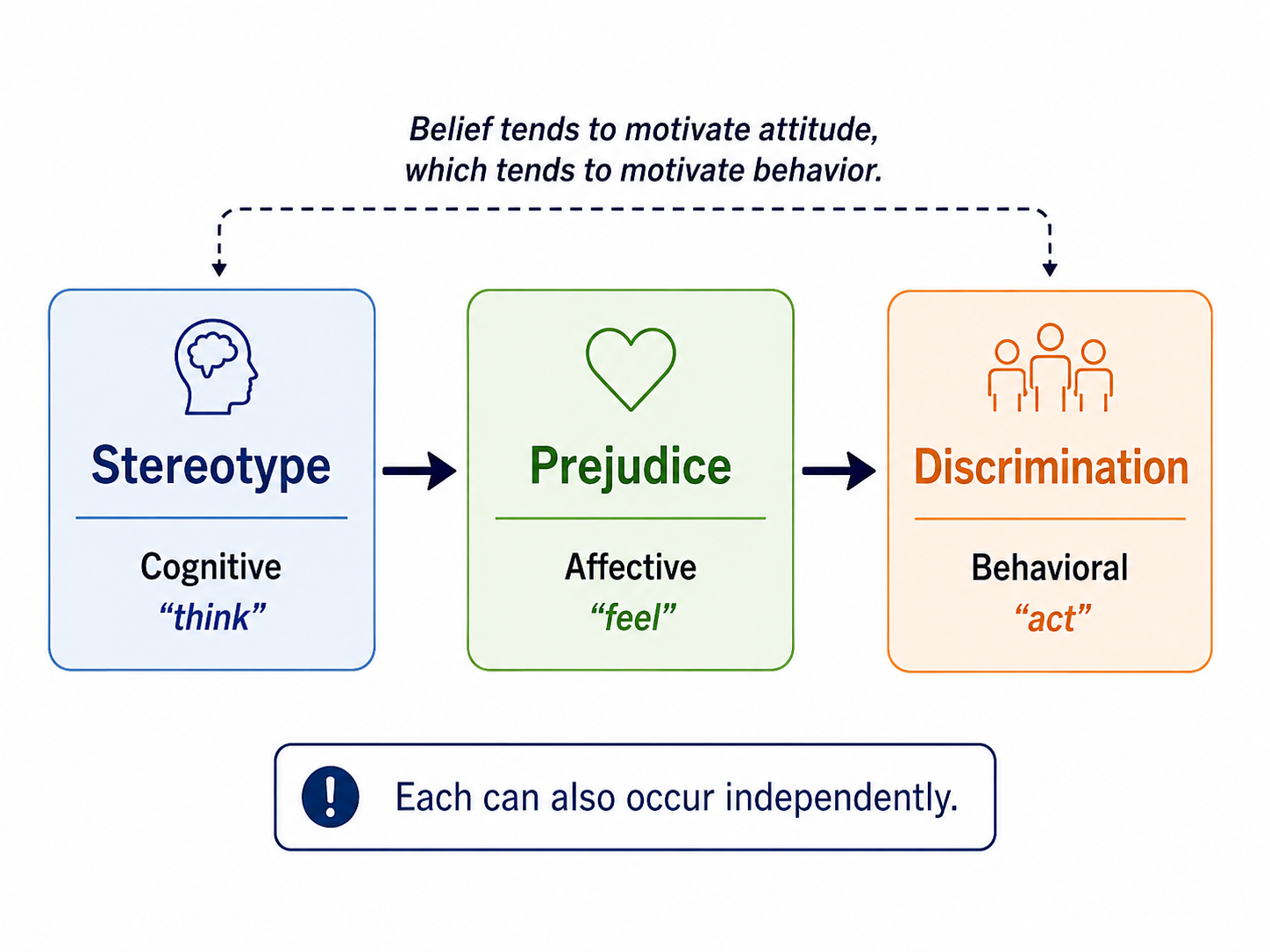
Must knowThe MCAT loves to distinguish these three.
Stereotypes are cognitive generalizations — beliefs about the typical characteristics of a group. They can be neutral or even seemingly "positive" ("Asian students are good at math"), but even positive stereotypes harm because they reduce individuals to group membership.
Prejudice is the affective (emotional) attitude — a pre-judgment, usually negative, toward a group based on group membership. It is the feeling: hostility, contempt, fear, distrust.
Discrimination is behavior — differential treatment based on group membership. It is the only one directly observable and often legally actionable. You can hold prejudice without discriminating, and discriminate without conscious prejudice (institutional discrimination, developed in the 8C Discrimination guide).
Shorthand: stereotype = think, prejudice = feel, discrimination = act (cognitive → affective → behavioral).
Quick check: A hiring manager "just has a feeling" she'd rather not hire someone who wears religious head coverings, though she acknowledges that person is qualified. Is this primarily a stereotype, a prejudice, or discrimination? Answer: It is primarily prejudice — an affective, negative attitude based on group membership. If she acts on it and rejects the applicant, that becomes discrimination.
Processes That Contribute to Prejudice
Social Categorization and In-Group/Out-Group Dynamics
Must knowCategorizing reduces cognitive load. The moment you categorize people, you create in-groups ("us") and out-groups ("them").
In-group bias (in-group favoritism) is the tendency to favor in-group members in evaluation and resource allocation. It does not require hating the out-group — it can arise from pure preference for the familiar.
The out-group homogeneity effect is perceiving out-group members as more similar to each other than in-group members are ("they all look/act alike"), while seeing rich diversity within our own group. This makes stereotyping easier.
Social identity theory (Tajfel & Turner): part of our self-concept comes from group membership, so to protect self-esteem we are motivated to see our in-group as superior. This is why even arbitrary assignments (Tajfel's minimal group paradigm — sorting by coin flip) produce in-group favoritism: categorization alone drives bias.
Quick check: Tajfel showed participants could exhibit in-group bias even when randomly assigned to meaningless groups. What does this demonstrate? Answer: It shows that prejudice and favoritism can emerge from mere categorization alone, without any history of conflict or real group differences. Social identity theory predicts this because people want their in-group to compare favorably.
Realistic Conflict Theory and Sherif's Robbers Cave Experiment
Must knowRealistic conflict theory (Sherif): intergroup hostility develops when groups compete for the same scarce resources (jobs, territory, status).
Sherif's Robbers Cave experiment (1954) split summer-camp boys into two groups, introduced competition, and watched hostility develop rapidly between previously friendly boys. Crucially, introducing superordinate goals — shared objectives neither group could achieve alone — reduced hostility (a high-yield passage hook).
Quick check: During an economic recession, prejudice against immigrant workers increases in a community. Realistic conflict theory would explain this as what? Answer: Competition over scarce jobs creates perceived threat, fueling hostility toward the out-group (immigrants) who are seen as rivals for resources.
The Contact Hypothesis (Allport's Intergroup Contact Theory)
Must knowThe canonical prejudice-reduction strategy is the contact hypothesis (Gordon Allport, 1954): intergroup contact reduces prejudice, but only under four conditions — (1) equal status, (2) common goals, (3) cooperation (not competition), and (4) institutional support (authority/law/custom). Robbers Cave's superordinate goals are these conditions in action. Without them, mere contact can entrench prejudice. Prejudice-reduction questions frequently hinge on recognizing these four conditions.
Quick check: Two rival groups are forced to share a workspace but with no shared objective and unequal status. Contact alone fails to reduce their mutual prejudice. Why? Answer: The contact hypothesis predicts contact reduces prejudice only under equal status, common goals, cooperation, and institutional support — none of which are met here.
Scapegoat Theory
Must knowWhen people feel frustrated or threatened by diffuse forces (e.g., economic hardship), they redirect that frustration onto a vulnerable, identifiable group. This is scapegoating: blaming an out-group for problems that are not their fault (frustration–aggression displaced onto a convenient target).
Social Learning Theory and the Transmission of Prejudice
Must knowPrejudice is also learned. Social learning theory (Bandura): children acquire prejudiced attitudes through modeling parents/peers/media and reinforcement, which is why prejudice persists even after its original "justifying" conditions are gone. Optional Adorno's authoritarian personality is low-yield and not tested in depth.
Jane Elliott's "blue eyes/brown eyes" exercise (1968): she split a grade-school class by eye color and treated one group as superior; within a day the "superior" children acted arrogantly and the "inferior" ones withdrew and underperformed — prejudice induced by an arbitrary label backed by authority.
Implicit Bias and the Implicit Association Test (IAT)
Must knowImplicit bias = attitudes/stereotypes that shape judgment and behavior automatically and unconsciously. The Implicit Association Test (IAT) (Greenwald) measures the strength of automatic associations via reaction times — slower pairing of a group with positive words suggests an implicit negative association.
This is distinct from explicit bias (consciously held, openly expressed). A person can explicitly endorse equality yet hold — and act on — implicit biases without realizing it.
Quick check: A physician consciously believes all patients deserve equal care, but prescribes less pain medication to Black patients than to demographically identical White patients. This discrepancy is best explained by what? Answer: Implicit bias — the physician's unconscious associations influence behavior even when explicit attitudes are egalitarian.
Power, Prestige, and Class
Know the logicPrejudice is embedded in structures that allocate power unevenly. Power (ability to impose one's will), prestige (social honor of a position), and class (socioeconomic position) all interact with prejudice: dominant groups use control over institutions to justify and entrench the hierarchy, which is why a powerful group's prejudice is so consequential.
Prejudice from a dominant group, backed by institutional power, translates into systematic discrimination — the sociological sense of prejudice + power = racism/sexism as a system versus mere individual negative attitudes. (How this becomes behavior — individual vs. institutional discrimination, de jure vs. de facto — is developed in the 8C Discrimination guide.)
Passage-levelRecognize the named "isms" — systematic prejudice toward a group: racism, sexism, ageism, classism, heterosexism/homophobia. Lower socioeconomic status (SES) marks greater exposure to discrimination and downstream health effects.
Quick check: A passage describes a dominant group whose members control hiring, lending, and lawmaking and use those positions to keep a minority group disadvantaged. Which two structural concepts most directly explain why this group's prejudice is so impactful? Answer: Power and prestige — control of institutions converts attitudes into systemic advantage, the sociological sense in which "prejudice + power" operates as a system.
The Role of Emotion in Prejudice
Know the logicPrejudice is by definition affective; emotion drives its intensity and determines what behavior it produces. Know the logic (intergroup emotions theory): specific emotions predict specific behaviors — fear predicts avoidance, disgust predicts dehumanization, envy predicts resentment/aggression.
Dehumanization — denying the full humanity of out-group members — is facilitated by disgust and contempt; it removes moral constraints and is historically linked to atrocity.
Threat (symbolic threat to values, realistic threat to resources) is a key emotional driver: perceived threat intensifies negative responses.
Some prejudice is emotionally ambivalent — e.g., benevolent sexism uses subjectively positive feelings (protectiveness, admiration) that nonetheless reinforce women's subordinate roles; the warmth masks the prejudice.
Quick check: Participants in a study feel disgust when shown images associated with a particular ethnic group. Based on intergroup emotions theory, what behavior would this most likely predict? Answer: Avoidance and dehumanization of that group, rather than (say) aggressive competition, which would be predicted more by anger or fear.
The Role of Cognition in Prejudice
Stereotypes as Cognitive Schemas
Must knowStereotypes function as schemas — mental frameworks that organize social information and conserve cognitive effort. Once activated, a stereotype automatically shapes perception, memory, and inference: you notice/remember confirming information (confirmation bias) and discount disconfirming information.
Illusory correlation: perceiving a relationship between a group and a trait when the actual association is weak or absent. It arises because distinctive pairings (minority group + distinctive negative behavior) are disproportionately memorable.
Self-Fulfilling Prophecy and Stereotype Threat
Must knowTwo processes turn stereotypes into outcomes and help prejudice persist: the self-fulfilling prophecy (a perceiver's expectations change how they treat a target, eliciting the expected behavior) and stereotype threat (a target's own awareness of a negative stereotype creates anxiety that impairs performance). Both are developed in full in the Processes Related to Stereotypes guide.
Fundamental Attribution Error and Just-World Hypothesis
Must knowThe fundamental attribution error (FAE) — overattributing others' behavior to disposition and underweighting situation — feeds prejudice: blaming a struggling person's personal failings rather than structural barriers maintains a negative stereotype.
The just-world hypothesis (Lerner): the belief that people get what they deserve, which leads to victim blaming — assuming the disadvantaged must have merited their fate. Comforting but it produces harsh judgments of disadvantaged groups.
Quick check: An observer concludes that members of a disadvantaged group are poor "because they don't work hard," ignoring the structural barriers they face. Which two cognitive biases are jointly at work? Answer: The fundamental attribution error (over-crediting disposition, under-weighting situation) and the just-world hypothesis (people get what they deserve) — together they sustain a negative stereotype through victim blaming.
Stereotypes
Must knowHow stereotypes form: categorization, illusory correlation, social learning, media. They are cognitively efficient (fast judgments), which is why they resist elimination.
How stereotypes persist: confirmation bias, selective attention/memory, self-fulfilling prophecy, and subtyping (treating a disconfirming individual as an "exception" rather than updating the stereotype).
Modern vs. old-fashioned prejudice: overt prejudice has declined, but subtler forms remain. Modern (symbolic) racism: denying discrimination still exists, resenting corrective policies, blaming disparities on cultural failings. Aversive racism (Gaertner & Dovidio): people who consciously hold egalitarian values yet harbor unconscious negative bias — they discriminate only in ambiguous situations where the behavior can be attributed to non-racial factors.
Passage-levelStereotype content model (Fiske): stereotypes vary on warmth and competence, predicting distinct emotions — high warmth/high competence → admiration; low warmth/high competence → envy; high warmth/low competence → pity; low warmth/low competence → contempt.
Quick check: A researcher finds that people view a certain professional group as highly competent but cold and untrustworthy. According to the stereotype content model, what emotion would this predict? Answer: Envy. High competence + low warmth maps onto envy in the stereotype content model.
Stigma
Must knowStigma (Goffman): a deeply discrediting attribute that reduces a person from "whole" to "tainted" in others' eyes. It is relational and socially constructed — the meaning is assigned, not inherent.
Three types: (1) abominations of the body — physical differences/disabilities; (2) blemishes of individual character — perceived moral failures (mental illness, addiction, criminal record); (3) tribal stigma — inherited through group membership (race, ethnicity, religion).
Discredited vs. discreditable: discredited = attribute already known/visible (manage tension); discreditable = not yet known (manage information — whether/when to disclose, i.e. "passing"). Courtesy stigma = stigma by association, extending to associates of a stigmatized person.
Health consequences: stigmatized people delay care, experience chronic stress from anticipated discrimination, and have reduced social support.
Quick check: A person with HIV conceals their status at work and with acquaintances, strategically deciding when to disclose to close friends. Using Goffman's terminology, what type of stigma does this person have, and what management strategy are they using? Answer: Discreditable stigma (the attribute is not apparent to others). They are managing information — "passing" by selectively disclosing only to trusted individuals.
Ethnocentrism
Must knowEthnocentrism (term coined by William Graham Sumner, 1906): evaluating other cultures using one's own culture's standards as the baseline, typically judging others as inferior or strange. It is in-group favoritism at the cultural level — one's own culture seen as natural/normal/superior. The key is the evaluative, hierarchical judgment (this distinguishes it from mere patriotism). It helps construct cultural stereotypes and justify discrimination and colonial oppression.
Quick check: A student from Country A reads about a marriage practice from Country B and concludes it is "backward" and "wrong" because it violates the norms she grew up with — without examining it on its own terms. This is an example of what? Answer: Ethnocentrism. She is judging Country B's practice by Country A's cultural standards.
Ethnocentrism vs. Cultural Relativism
Must knowThe opposite of ethnocentrism is cultural relativism: understanding a culture's practices within the context of its own norms and circumstances, rather than judging them against an external standard. It does not mean every practice is beyond critique — it means understanding requires context, and apparent "strangeness" often dissolves once you grasp a practice's internal logic and function.
| Dimension | Ethnocentrism | Cultural Relativism |
|---|---|---|
| Evaluation standard | Own culture as the universal yardstick | Internal to the culture being examined |
| Outcome | Judgment and hierarchy between cultures | Understanding and contextual interpretation |
| Risk | Prejudice, cultural imperialism | Can slide into moral relativism if taken to extremes |
| MCAT relevance | Links to in-group bias, stereotyping, discrimination | Links to cultural competency, reducing bias |
The MCAT tests distinguishing these in passages: watch for a researcher describing a practice (relativism) vs. judging it (ethnocentrism).
Xenocentrism = preference for foreign cultures over one's own (the mirror image of ethnocentrism).
Quick check: An anthropologist studying a tribe avoids concluding that their gender roles are "inferior" to Western ones, instead attempting to understand how those roles function within the tribe's social and ecological context. This anthropologist is practicing what? Answer: Cultural relativism — judging the practice by standards internal to the culture rather than imposing outside norms.
Common Confusions & Tricks
Stereotype ≠ Prejudice ≠ Discrimination. These three are related but distinct. On the MCAT, you will be asked to identify which is operating in a given scenario. Remember: cognitive/belief (stereotype) → emotional/attitude (prejudice) → behavioral (discrimination). All three can exist independently.
Stereotype threat is NOT the same as a self-fulfilling prophecy. In stereotype threat, the stereotyped person fears confirming the stereotype and underperforms due to that anxiety. In a self-fulfilling prophecy, an outside person's expectations change their behavior toward the target, which then causes the target to fulfill the expectation. The locus of mechanism is different.
Ethnocentrism vs. cultural relativism on the MCAT: A passage about a researcher "suspending judgment" or "understanding practices in context" = cultural relativism. A passage about someone using their own culture's norms to label another culture as inferior = ethnocentrism. These are almost always answer-choice contrasts on the exam.
Stigma types (Goffman): Discredited vs. Discreditable. Discredited = already known/visible (managing tension). Discreditable = not yet known (managing information). Students frequently reverse these. Tip: "Discreditable" still has potential to discredit you — you're managing whether it does.
Realistic conflict theory (Sherif) vs. Social identity theory (Tajfel & Turner): Sherif says prejudice comes from real competition for resources. Tajfel says prejudice can arise from mere categorization and the need for positive social identity — even without resource competition. These can be tested as contrasting explanations for the same behavior.
Illusory correlation is NOT confirmation bias. Confirmation bias is seeking/remembering evidence that fits your existing belief. Illusory correlation is perceiving a relationship that doesn't exist (or is weaker than perceived), often because paired rare events are both distinctive and thus memorable together.
Modern racism and aversive racism are different from old-fashioned racism — and the MCAT loves to test whether you know that prejudice can operate subtly. If a passage shows someone who claims not to be racist but discriminates in ambiguous situations, think aversive racism (Gaertner & Dovidio).
"Positive" stereotypes are still stereotypes. The MCAT may describe a scenario where someone is treated differently because of a favorable group assumption. That is still stereotype-based discrimination.
Just-world hypothesis → victim blaming. Whenever a passage shows someone attributing a disadvantaged person's situation to personal failings while ignoring structural causes, connect it to the just-world hypothesis.
Key Theories & Terms
| Term / Theory / Researcher | One-sentence summary |
|---|---|
| Stereotype | A cognitive generalization about the typical characteristics of members of a social group. |
| Prejudice | An affective (emotional) attitude — usually negative — toward a group based solely on group membership. |
| Discrimination | Differential treatment or behavior toward individuals based on their group membership. |
| In-group bias | The tendency to evaluate and favor members of one's own group over out-group members. |
| Out-group homogeneity effect | The perception that out-group members are more similar to each other than in-group members are. |
| Social identity theory | Tajfel & Turner: part of self-concept derives from group membership, motivating favorable comparisons of in-group over out-group. |
| Minimal group paradigm | Tajfel: even arbitrary, meaningless group assignments produce in-group favoritism, showing categorization alone drives bias. |
| Realistic conflict theory | Sherif: intergroup hostility arises from competition over scarce resources; superordinate goals can reduce it. |
| Robbers Cave experiment | Sherif (1954): classic demonstration that competition between boys' groups rapidly produced prejudice and hostility. |
| Contact hypothesis | Allport (1954): intergroup contact reduces prejudice under equal status, common goals, cooperation, and institutional support. |
| Jane Elliott — blue eyes/brown eyes | (1968) Classroom demonstration that prejudice and its effects can be induced rapidly by an arbitrary group label backed by authority. |
| The "isms" | Systematic prejudice/discrimination toward a group: racism, sexism, ageism, classism, heterosexism/homophobia. |
| Scapegoat theory | Frustration or diffuse threat is redirected as hostility toward a convenient, vulnerable out-group. |
| Authoritarian personality | Adorno: rigid conventionalism and submission to authority associated with prejudice (low-yield; not tested in depth). |
| Implicit bias | Unconscious attitudes and associations that automatically shape judgments and behavior. |
| Implicit Association Test (IAT) | Greenwald: measures strength of automatic mental associations via reaction time; reveals implicit biases. |
| Explicit bias | Consciously held and openly expressed prejudiced attitudes. |
| Illusory correlation | Perceiving a relationship between a group and a trait when the actual association is absent or weaker than believed. |
| Confirmation bias | The tendency to seek, notice, and remember information that confirms existing beliefs (including stereotypes). |
| Stereotype threat / Self-fulfilling prophecy | Two processes that turn stereotypes into outcomes (covered in full in the Processes Related to Stereotypes guide); both help prejudice persist. |
| Fundamental attribution error (FAE) | Overattributing others' behavior to disposition and underweighting situational factors; sustains prejudice against disadvantaged groups. |
| Just-world hypothesis | Lerner: the belief that people get what they deserve, leading to victim blaming and harsh judgments of disadvantaged groups. |
| Modern racism / Aversive racism | Subtle, indirect forms of prejudice; aversive racism (Gaertner & Dovidio) involves unconscious bias in people who consciously hold egalitarian values. |
| Stereotype content model | Fiske: stereotypes vary on warmth and competence dimensions, predicting distinct emotional responses (admiration, envy, pity, contempt). |
| Stigma | Goffman: a deeply discrediting social attribute that reduces an individual to a "tainted" identity in others' eyes. |
| Abomination of the body | Goffman's stigma type: visible physical differences or disabilities. |
| Blemishes of individual character | Goffman's stigma type: perceived moral failures (addiction, mental illness, criminal record). |
| Tribal stigma | Goffman's stigma type: stigma inherited through group membership (race, ethnicity, religion). |
| Discredited stigma | Stigma that is already known or visible; the person manages social tension. |
| Discreditable stigma | Stigma not yet known to others; the person manages information disclosure. |
| Courtesy stigma | Stigma extended to associates of a stigmatized individual. |
| Ethnocentrism | Sumner: judging other cultures using one's own culture's standards as the universal baseline, often concluding one's own is superior. |
| Cultural relativism | The principle that a culture's practices should be understood within their own context, not judged by external cultural standards. |
| Xenocentrism | Preference for foreign cultures over one's own; the reverse of ethnocentrism. |
| Social learning theory (Bandura) | Prejudice is acquired through observation and reinforcement of others' prejudiced attitudes and behaviors. |
| Benevolent sexism | Subjectively positive but paternalistic attitudes toward women that nonetheless reinforce subordinate roles. |