Stereotypes don't just sit in the mind as passive categories — they actively shape behavior in the people who hold them and in the people they target. The two most testable mechanisms are the self-fulfilling prophecy and stereotype threat. Both show how social expectations can become self-reinforcing realities, with implications for health, education, and behavior.
Priority labels: Must know = cold; Know the logic = mechanism not names; Passage-level = recognize, don't memorize; Optional = skippable.
What Is a Stereotype?
Must knowA stereotype is a generalized belief about the attributes of a social group. Keep three terms distinct: stereotype (a belief), prejudice (an attitude — an emotional evaluation), and discrimination (behavior — treating people differently by group membership).
Stereotypes can be explicit (consciously endorsed) or implicit (automatic, often unconscious associations, measured by the Implicit Association Test, or IAT). Both can influence behavior.
Self-Fulfilling Prophecy
The Core Idea
Must knowA teacher believes a student is exceptionally talented, and without realizing it gives that student more encouragement, attention, and charitable interpretation of mistakes. The student rises to meet those expectations and performs well — so the teacher's original belief, even if baseless, made itself come true.
This is the self-fulfilling prophecy: an initially false belief leads to behaviors that make the belief become true. Coined by sociologist Robert Merton (1948). The key phrase is initially false — the belief didn't describe reality, it created it.
The mechanism is a loop:
- Person A holds an expectation about Person B.
- A's behavior toward B changes based on that expectation (often unconsciously).
- B's behavior shifts in response.
- The outcome confirms A's original expectation.
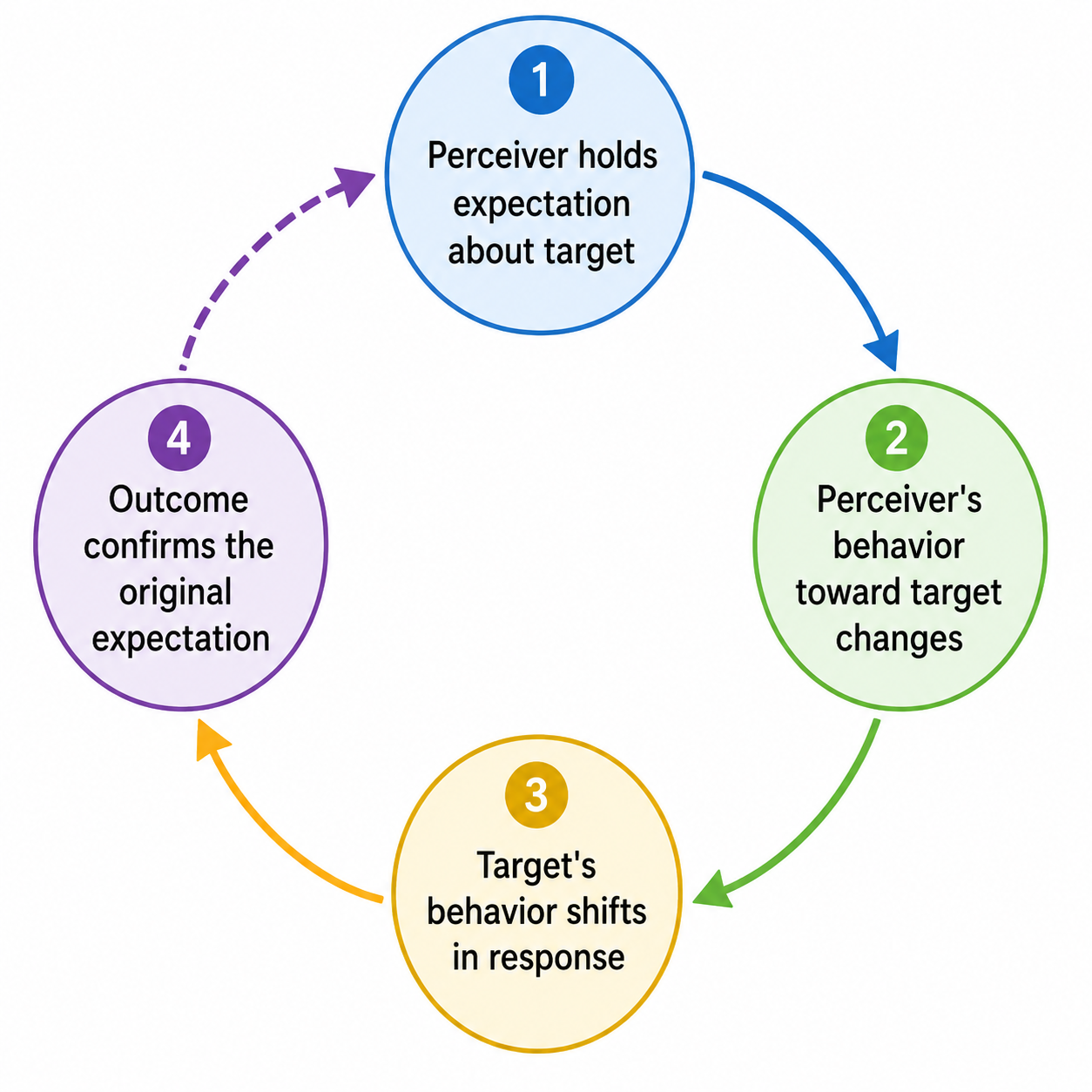
The confirmation feels like evidence, but it was manufactured by the expectation itself — which is why the prophecy is hard to detect from the inside.
The Pygmalion Effect: Rosenthal & Jacobson (1968)
Must knowThe classic demonstration in education is the Pygmalion effect (psychologist Robert Rosenthal and principal Lenore Jacobson). They told teachers that certain students — chosen at random — were "intellectual bloomers" poised for an academic surge. By year's end, those labeled bloomers showed significantly greater IQ gains. Teacher expectations changed how they treated those students (more warmth, stimulation, feedback), and the students responded.
The flip side is the Golem effect: low expectations lead to decreased performance (less attention, simpler material, fewer challenges → worse outcomes).
Behavioral Confirmation
Must knowBehavioral confirmation is the interpersonal mechanism behind the self-fulfilling prophecy: a perceiver's expectations cause the target to behave in ways that confirm those expectations, regardless of the belief's initial accuracy. Snyder & Swann demonstrated this — people told their partner was hostile asked more hostile questions, which elicited more hostile responses.
Self-Fulfilling Prophecy and Health
Passage-levelOn the MCAT, watch for the clinical hook: a clinician's expectations about a patient's prognosis or adherence can shape the care provided, which shapes outcomes. A physician who assumes a low-income patient won't adhere may prescribe a simpler, less effective regimen — and the worse outcome appears to "confirm" the assumption.
Quick Check
Scenario: A manager assumes a new hire from a certain demographic group won't be a strong leader, so he never gives her high-visibility assignments. With no chance to demonstrate her abilities, she stays in junior roles — which he later cites as confirmation he was right.
Which concept does this illustrate, and what is the mechanism?
Answer: Self-fulfilling prophecy (specifically behavioral confirmation). The manager's unjustified expectation changed his behavior (withholding opportunities), which constrained her outcomes, and the result appeared to validate the expectation — even though the expectation itself caused the outcome.
Stereotype Threat
The Core Idea
Must knowStereotype threat is anxiety or concern about confirming a negative stereotype about one's own group. Crucially, you don't have to believe the stereotype for it to affect you — simply being aware it exists, and that your performance could confirm it, is enough to impair performance.
It is situational: the same person performs differently depending on whether the stereotype-relevant context is activated. The point isn't fixed ability — it's how context shapes performance.
Steele & Aronson (1995): The Foundational Study
Must knowPsychologists Claude Steele and Joshua Aronson had Black and white students take a difficult verbal test. When it was framed as diagnostic of intellectual ability, Black students performed significantly worse than white students (controlling for preparation); when framed as non-diagnostic, the gap essentially disappeared. The mere salience of the negative stereotype was sufficient to impair performance — no one had to say anything explicitly racist; the context activated the threat.
Mechanism: How Stereotype Threat Hurts Performance
Know the logicThe unifying idea: threat-related worry consumes resources needed for the task. Channels the MCAT may invoke:
- Working-memory load: monitoring performance and managing anxiety leaves fewer resources for the task — especially damaging on complex tasks (reasoning, verbal fluency, math), plus intrusive negative thoughts ("what if I prove them right?").
- Arousal/anxiety: increased physiological arousal hurts complex cognitive tasks.
- Reduced effort / disengagement: some people chronically disengage ("I'm just not a math person") as self-protection — this disidentification detaches self-worth from performance but lowers effort over time.
Who Is Affected, and When?
Must knowStereotype threat can affect any group with a relevant negative stereotype in context. Classic tested domains: race and standardized testing; gender and math. Passage-level Other documented cases: white men on athletic tasks, elderly adults on memory tasks, first-generation college students.
The threat is strongest when the person identifies strongly with the domain (more at stake), the stereotype is salient, the task is challenging, and the person belongs to the stereotyped group and is aware of the stereotype.
Stereotype Lift and Stereotype Boost
Must knowTwo converse phenomena that improve performance, and common distractors:
- Stereotype lift: a non-stereotyped (often dominant) group's boost from a downward comparison to a negatively stereotyped out-group.
- Stereotype boost: a boost from activating a positive in-group stereotype. Classic case: priming Asian women's Asian identity (positively stereotyped for math) improves performance, while priming their female identity produces stereotype threat — the primed identity sets the direction.
Distinguish: lift = downward comparison to a negatively stereotyped out-group; boost = activation of a positive in-group stereotype.
Reducing Stereotype Threat
Know the logicInterventions work by removing the threat or buffering the self:
- Self-affirmation: writing about core values before a test reinforces self-integrity (Steele and colleagues).
- Reframing the task as non-diagnostic of ability removes the threatening context.
- Role models / belonging: exposure to successful in-group members reduces threat.
- Growth mindset: teaching that intelligence is malleable lowers the stakes of any single performance.
- Reducing salience: avoiding identity reminders before high-stakes tasks (e.g., no demographic questions right before an exam).
Quick Check
Scenario: A female engineering student who loves math (central to her identity) is about to take a calculus exam. The professor reminds the class that "studies show men tend to outperform women in quantitative fields." She performs well below her usual level.
What concept is this, and what makes the effect particularly strong?
Answer: Stereotype threat. The comment made the negative stereotype salient. It's especially strong because (1) she identifies strongly with the domain (higher stakes); (2) the stereotype was explicitly activated right before performance; and (3) the exam involves complex, effortful cognition, so the working-memory drain from anxiety is especially damaging.
Connecting the Two Processes
Must knowThe two combine in real-world achievement gaps. A teacher with stereotyped expectations provides less challenging work to certain students (self-fulfilling prophecy — outside in, perceiver to target). At the same time, students from negatively stereotyped groups feel anxiety about confirming the stereotype, impairing performance (stereotype threat — inside out, within the target). Both compound — which is why stereotypes can have powerful, persistent effects even when no one consciously endorses them.
Common Confusions & Tricks
Self-fulfilling prophecy vs. stereotype threat: outside vs. inside.
The key distinction: self-fulfilling prophecy is driven by the perceiver's expectations changing their behavior toward the target. Stereotype threat is driven by the target's own awareness of a stereotype changing their own performance — even if no one else in the room holds the expectation.
Stereotype threat doesn't require believing the stereotype.
A wrong answer says it only affects people who personally believe the stereotype. False — awareness that others might apply it is sufficient. Not "I'm bad at math," just "people think people like me are, and I don't want to confirm that."
Pygmalion = positive expectations; Golem = negative ones.
Mnemonic: Pygmalion created something from nothing (sculptor → statue comes to life) → expectations elevating performance. Golem is a creature of clay, inert → low expectations depressing performance.
Stereotype threat is strongest for high-identifiers, not weak ones.
Someone who cares deeply about a domain is more vulnerable in it. If you don't care about math, "I might confirm my group is bad at math" has no teeth.
Behavioral confirmation is the mechanism, not a synonym, for self-fulfilling prophecy.
Behavioral confirmation is the interpersonal process (perceiver's behavior → target's behavior); the self-fulfilling prophecy is the broader outcome (an initially false belief becoming true). The gear vs. the machine it drives.
Stereotype threat affects cognitive performance, not just motivation.
The acute Steele & Aronson (1995) effect was cognitive impairment via working-memory load and anxiety — not trying less hard. High-effort individuals can still be impaired (chronic disengagement is a separate, longer-term response).
Key Theories & Terms
| Term / Name | What It Means / Who |
|---|---|
| Stereotype | A generalized belief about a social group's characteristics; distinct from prejudice (attitude) and discrimination (behavior). |
| Self-fulfilling prophecy | Robert Merton: an initially false belief causes behaviors that make the belief come true. |
| Pygmalion effect | Rosenthal & Jacobson (1968): teacher expectations of high performance led to actual gains, even when randomly assigned. |
| Golem effect | Negative counterpart: low expectations lead to lower performance. |
| Behavioral confirmation | Snyder & Swann: a perceiver's expectations change how they treat a target, eliciting confirming behavior. |
| Stereotype threat | Steele & Aronson (1995): awareness one could confirm a negative group stereotype causes anxiety that impairs performance, especially on hard tasks. |
| Stereotype lift | Boost a non-stereotyped group gains from a downward comparison to a negatively stereotyped out-group. |
| Stereotype boost | Boost from activating a positive in-group stereotype (e.g., priming Asian identity improves math performance). |
| Claude Steele | Introduced/studied stereotype threat (with Aronson); developed self-affirmation as an intervention. |
| Joshua Aronson | Co-author of the 1995 stereotype threat study. |
| Robert Merton | Coined "self-fulfilling prophecy" (1948). |
| Robert Rosenthal | Demonstrated teacher expectancy effects (Pygmalion study). |
| Implicit Association Test (IAT) | Measures automatic (implicit) associations, including stereotyped group traits. |
| Self-affirmation | Affirming core values before a high-stakes task reduces stereotype threat. |
| Disidentification | Chronically threatened individuals detach self-worth from a domain, reducing motivation over time. |
| Working memory | System for holding/manipulating information; stereotype threat impairs it via threat-monitoring and anxiety. |
| Explicit vs. implicit stereotype | Explicit = consciously endorsed; implicit = automatic, unconscious (measured by IAT). |