Culture is one of the most powerful forces shaping human thought and social life — yet it is so pervasive that people rarely notice it. For the MCAT, treat culture as a structured system with specific components, dynamics, and measurable effects on individuals and societies.
Priority labels: Must know = cold; Know the logic = mechanism not names; Passage-level = recognize, don't memorize; Optional = skippable.
What Is Culture?
Must knowThink of culture as the shared software a group runs — the learned rules, meanings, and assumptions that make coordinated social life possible. The defining feature is that culture is learned, not innate: it is transmitted socially, not genetically (this is Edward Tylor's classic 1871 sense of culture as a "complex whole" of knowledge, belief, art, morals, and custom).
Distinguish culture from society: a society is a group sharing a territory and interacting; culture is the system of meanings and practices they share. You can have one society with many cultures (a multicultural nation), but no culture without a group to carry it.
Quick check: Is language an example of culture? Yes — language is learned, shared, and transmits meaning, making it a core cultural element.
Elements of Culture
Must knowCulture is a web of interconnected components.
- Beliefs — ideas held to be true about the world (descriptive: "hard work leads to success"). They are the cognitive foundation for values and norms.
- Values — shared judgments about what is desirable or good (evaluative: "honesty is important"). Values prioritize goals and guide choices.
- Norms — rules governing behavior (what people should do):
- Folkways — mild everyday-courtesy norms; violation brings mild disapproval.
- Mores (MORE-ays) — stronger moral norms tied to core values (e.g., not stealing).
- Taboos — absolute prohibitions whose violation causes revulsion (incest, cannibalism).
- Laws — formally codified, government-enforced norms.
- Sanctions (rewards/punishments) are the social-control mechanisms that enforce norms.
- Symbols — anything carrying a shared meaning beyond its physical form (a red octagon = "stop"). Language is itself a symbol system.
- Language — see Sapir-Whorf below.
- Rituals — formalized, repeated symbolic actions that mark transitions or reinforce solidarity (ceremonies, handshakes); they make abstract values visible and communal.
Values vary across cultures along dimensions like individualism vs. collectivism and power distance (Hofstede). Recognize the terms; don't memorize the full list.
Sapir-Whorf hypothesis (linguistic relativity): the language you speak influences how you perceive and think. The strong form (linguistic determinism — language determines thought) is largely rejected; the weak form (language influences thought) is the supported version. The strong/weak distinction is the key testable point.
These elements form an integrated system: beliefs justify values; values generate norms; symbols and language encode them; rituals enact them. When one element changes, it pressures the others — the basis of culture lag.
Quick check: A hospital starts a daily "huddle" of nurses and doctors to improve communication. What cultural elements are being constructed? Norms (expected gathering), a ritual (formalized, repeated), and potentially a new value (open communication).
Material vs. Symbolic Culture
Must knowThis distinction is core. Material culture is the physical stuff — tools, clothing, architecture, smartphones (tangible). Symbolic (nonmaterial) culture is the intangible — beliefs, values, norms, language, rituals, symbols. Symbolic culture gives material objects meaning (a wedding ring is metal; its meaning is symbolic).
This matters because material and symbolic culture change at different rates — the basis of culture lag.
Quick check (scenario): A society invents the internet (material), but privacy laws and online norms haven't caught up. Which is changing faster? Material culture is ahead; symbolic culture lags. This is culture lag.
Culture Lag
Must knowCulture lag (coined by William F. Ogburn, 1922) is the period of maladjustment when one part of culture — typically material/technological — changes faster than another part — typically symbolic/normative. The "lag" is the gap, and the direction is fixed: symbolic culture trails material culture, because norms and laws require slow human consensus while technology diffuses fast.
Classic MCAT examples: genetic-testing tech outpacing genetic-privacy law (GINA); social media preceding norms on cyberbullying and misinformation; automobiles spreading before traffic laws. The lag causes real harm (people are harmed before protective norms exist).
Quick check: A country rapidly industrializes but its environmental and workplace-safety laws haven't changed; workers are harmed. Culture lag? Yes — material culture (industrial machinery) advanced faster than symbolic culture (laws, norms about worker protection).
Ethnocentrism, Cultural Relativism, and Cultural Universals
Must knowHow a person evaluates another culture is heavily tested. Focus on these three:
- Ethnocentrism — judging another culture by the standards of one's own, treating one's own as superior or the natural norm. Underlies prejudice and culture shock; a clinician who dismisses a patient's traditional healing as "backward" is being ethnocentric.
- Cultural relativism — understanding a culture on its own terms, within its own context. In medicine it underlies cultural competence — taking a patient's health beliefs seriously. (Relativism as method does not require abandoning all ethical judgment.)
- Cultural universals (George Murdock) — elements found in essentially all societies (family/kinship, language, religion, marriage, the incest taboo, rites of passage). Their near-universality suggests they meet fundamental human needs, though specific forms vary.
Quick check: A traveler insists eating with one's hands is "uncivilized" because their culture uses forks. Which concept, and the corrective? Ethnocentrism — judging by one's own standards; the corrective is cultural relativism.
Culture Shock
Must knowCulture shock (coined by anthropologist Kalervo Oberg, 1960) is the disorientation, anxiety, and stress of entering an unfamiliar culture where your usual social maps no longer work. It is a predictable response, not weakness.
Stages of Culture Shock
Must knowOberg's classic U-curve runs in this order:
- Honeymoon — initial excitement; everything feels novel.
- Frustration/crisis — reality sets in (language barriers, isolation, misunderstandings). The bottom of the U and the most stressful phase; anxiety, homesickness, and hostility toward the host culture are common.
- Adjustment/recovery — patterns become recognizable; coping strategies develop.
- Adaptation/mastery — the person functions effectively, often feeling bicultural.
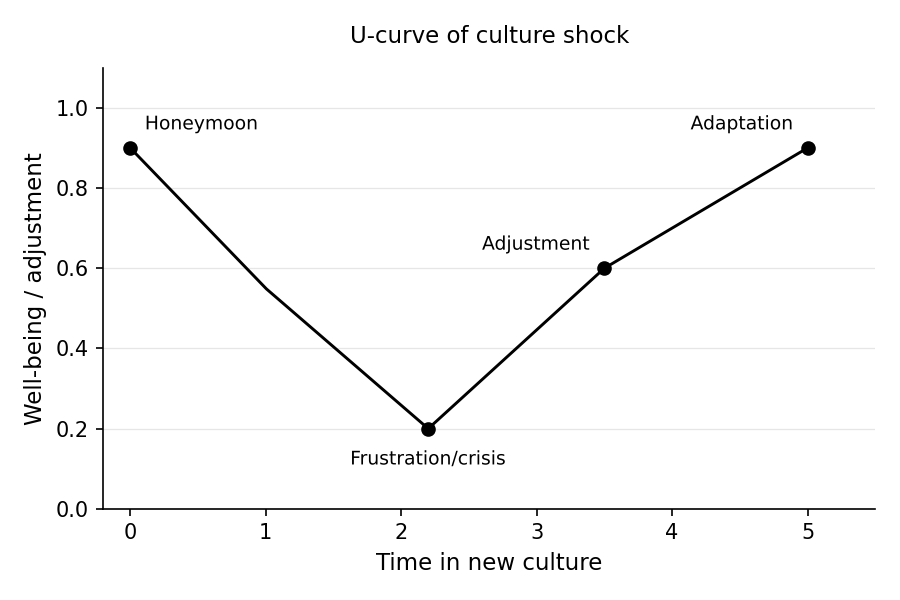
Some models add reverse (re-entry) culture shock when returning home feels unfamiliar.
Why it matters: immigrants in the frustration stage show elevated stress, depression, and psychosomatic symptoms — a passage may ask you to identify the phase or link it to psychosocial stressors and the HPA stress response.
Quick check (scenario): A medical student on a six-month rotation abroad is first enthusiastic, then by month two frustrated and homesick and criticizing local customs, then by month four has local friends and navigates markets easily. Which stages? Honeymoon → Frustration → Adjustment.
Assimilation
Must knowAssimilation is the process by which an individual or group adopts the dominant culture so thoroughly they become indistinguishable from it — the "melting pot" model (give up heritage culture, blend in).
OptionalMilton Gordon (1964) noted cultural assimilation/acculturation (adopting language, dress, customs) happens relatively fast, while structural assimilation (entering the dominant group's institutions) is much slower — immigrants adopt English quickly but face employment and housing discrimination for generations.
Berry's Acculturation Framework
Must knowJohn Berry frames assimilation as one of four acculturation strategies, defined by two questions: maintain heritage culture? and adopt dominant culture? The resulting 2×2:
| Maintain heritage culture? | ||
|---|---|---|
| Adopt dominant culture? | Yes | No |
| Yes | Integration | Assimilation |
| No | Separation | Marginalization |
- Integration — keep heritage culture and adopt dominant culture (bicultural); best psychological outcomes.
- Assimilation — give up heritage, adopt dominant.
- Separation — keep heritage, reject dominant (ethnic enclave).
- Marginalization — lose heritage without adopting dominant; worst outcomes.
This is MCAT-relevant in passages on immigrant health disparities.
Quick check (scenario): A family keeps Mandarin at home and celebrates Chinese New Year, but the children speak fluent English, attend mainstream schools, and play school sports. Which strategy? Integration — maintaining heritage while participating in the dominant culture.
Multiculturalism
Must knowIf assimilation is the melting pot, multiculturalism is the "salad bowl" — distinct cultural groups coexist, each keeping its identity, while sharing civic life. It is both a descriptive claim (societies are diverse) and a normative stance that diversity should be valued (sometimes called cultural pluralism). It goes beyond mere tolerance by actively valuing diversity, and corresponds to Berry's "integration" at the societal level.
Passage-levelWhen minority cultures are pressured to assimilate (abandon heritage culture), health outcomes often worsen.
Quick check: A city offers services in five languages and holds festivals celebrating each ethnic community. Assimilation or multiculturalism? Multiculturalism — accommodating and celebrating diverse identities rather than pressuring one dominant culture.
Subcultures and Countercultures
Must know- Subculture — a group within a larger culture that shares much of the dominant culture but has its own distinctive values, norms, and practices. It is not in opposition (e.g., medical students with their jargon and white-coat ceremony, gamers, regional cultures).
- Counterculture — a subculture that actively rejects and challenges the dominant culture's values, often deliberately inverting them (e.g., the 1960s hippie movement, punk culture).
The key distinction: subcultures differ; countercultures oppose.
Quick check (scenario): College students reject the university's emphasis on grades and consumerism, refuse to use money within the group, and protest the consumerism around them. Subculture or counterculture? Counterculture — actively challenging and opposing dominant values, not merely differing.
Mass Media and Popular Culture
Must knowPopular culture is the widespread, mass-produced, mass-consumed cultural products of the general population (TV, film, music, social media, sports). Contrast with high culture (opera, fine art). Passage-level the high-vs-popular distinction is also a stratification marker — command of high culture functions as cultural capital (Bourdieu), signaling and reproducing social status. Pop culture isn't just entertainment; it transmits values, norms, and stereotypes.
Mass media are channels reaching large audiences simultaneously — the primary vehicle for producing and spreading popular culture. Know the logic of these media-effect theories (don't memorize statistics):
- Agenda-setting (McCombs & Shaw) — media doesn't tell you what to think but shapes what you think about, by choosing which issues to cover.
- Cultivation theory (Gerbner) — heavy, long-term media exposure gradually distorts perceptions of reality; heavy TV viewers overestimate violence and crime ("mean world syndrome"). High-yield for media-and-health passages.
- Framing — how media presents information (angle, emphasis) shapes interpretation ("crime wave" vs. "poverty crisis").
Social media drives rapid cultural diffusion, new online subcultures, and health effects (social comparison, body image).
Quick check (scenario): After weeks of shark-attack documentaries, Americans overestimate the risk of shark attacks. Which theory? Cultivation theory — prolonged exposure distorts perceived real-world risk (Gerbner's "mean world syndrome").
Evolution and Human Culture
Must knowHumans are uniquely dependent on culture — it is our primary adaptive strategy, letting us learn from others and accumulate knowledge far faster than genetic evolution allows.
Biocultural evolution is the co-evolution of biological traits and cultural practices. The flagship example — lactase persistence. Most mammals lose lactose digestion after weaning, but populations with dairy-farming cultures evolved high frequencies of the gene variant keeping lactase active into adulthood. The cultural practice created the selective pressure — culture drove genetic change.
Gene-culture coevolution (dual inheritance theory; Boyd & Richerson) formalizes this: genes and culture are two interacting inheritance systems. Cultural practices create new selective environments that shift allele frequencies, and genetic predispositions make certain practices more likely. Optional examples: cooking favored smaller jaws/guts and bigger brains; the Baldwin effect (a useful learned behavior can, over generations, favor genes that make it easier to learn).
Passage-levelSociobiology (E.O. Wilson) proposed that social behaviors reflect natural selection on genetic predispositions — this is not genetic determinism. Evolutionary psychology extends this to evolved mental mechanisms (e.g., the Westermarck effect — people raised together find each other sexually unattractive — as a basis for the incest taboo).
Quick check (scenario): Herding cultures show much higher rates of the adult-lactose-digestion variant than neighboring farming cultures. This is an example of what? Gene-culture coevolution (biocultural evolution) — pastoralism created selective pressure for lactase persistence.
Transmission and Diffusion
Must knowCulture moves through two mechanisms — transmission (within a culture) and diffusion (between cultures). This within-vs-between distinction is the testable point.
Cultural transmission passes culture along, closely tied to socialization (the lifelong process of learning culture):
- Vertical — parent/older generation to child (primary intergenerational continuity).
- Horizontal — between peers (teens adopting slang).
- Oblique — from non-parental elders (teachers, media) to youth.
Cultural diffusion is the spread of cultural elements between societies via trade, media, tourism, or conquest — no migration required. Know the logic of the types (recognize, don't drill):
- Direct contact — neighboring cultures borrow through sustained interaction.
- Indirect/intermediate — spread through intermediaries (Greek philosophy reaching Europe via Arabic scholars).
- Stimulus diffusion — the idea spreads but the receiving culture re-invents its own form.
Acculturation vs. diffusion: diffusion is the spread of elements; acculturation is the changes within a culture resulting from sustained contact (the outcome of diffusion), and can be bidirectional.
Cultural imperialism — a dominant culture spreads so aggressively it displaces others (e.g., global American fast food, film, and music at the expense of local traditions). This is diffusion at its most coercive and asymmetric.
Quick check (scenario): A Brazilian who has never visited the U.S. wears Nike, listens to American hip-hop, and uses American slang, all via social media and streaming. Diffusion or transmission? Cultural diffusion — specifically indirect-contact diffusion, spreading between societies without person-to-person contact.
Common Confusions & Tricks
1. Culture lag direction — symbolic always lags material, never the reverse. By Ogburn's definition, norms, values, and laws fail to keep up with technology. Ethical or legal gaps following innovation = culture lag every time.
2. Assimilation vs. integration (Berry). Assimilation = give up heritage culture. Integration = keep heritage while also adopting dominant culture. The healthiest outcome in Berry's research is integration, not assimilation — counterintuitive to students who assume "blending in" is best.
3. Subculture vs. counterculture — the key is opposition. Merely different → subculture. Actively challenges/rejects dominant values → counterculture.
4. Cultivation vs. agenda-setting. Agenda-setting: media shapes which topics matter (salience). Cultivation: media shapes your perception of reality via long-term exposure (distorted worldview). Heavy long-term TV + distorted beliefs → cultivation (Gerbner).
5. Culture shock stages — keep the order. Honeymoon → Frustration → Adjustment → Adaptation ("Happy Folks Adjust Admirably"). Don't put adaptation before adjustment or the crisis first.
6. Diffusion vs. transmission — source matters. Transmission = within a culture, across generations/peers (socialization). Diffusion = between cultures, from the outside in.
7. Sapir-Whorf — strong vs. weak. Strong form (language determines thought) is mostly rejected; weak form (language influences thought) has support. The supported version is the weak form (linguistic relativity, not determinism).
8. Sociobiology ≠ genetic determinism. Wilson's sociobiology claims selection shaped predispositions that culture and environment then modulate — not that "genes control culture."
Key Theories & Terms
| Term / Theorist | What It Means / Who They Are |
|---|---|
| Edward Tylor | Anthropologist; classic definition of culture as a learned "complex whole" acquired as a member of society |
| Geert Hofstede | Identified cross-cultural value dimensions (individualism/collectivism, power distance, etc.) |
| Symbolic interactionism (Mead) | People act toward things based on meanings that arise through social interaction |
| Sapir-Whorf hypothesis | Linguistic relativity — language influences (weak, supported) or determines (strong, rejected) thought |
| Material vs. symbolic culture | Tangible artifacts vs. intangible beliefs, values, norms, language, rituals, symbols |
| William F. Ogburn / Culture lag | Maladjustment when material culture changes faster than symbolic culture |
| Ethnocentrism | Judging another culture by one's own standards as superior/the norm |
| Cultural relativism | Evaluating a culture on its own terms; basis of cultural competence in medicine |
| Cultural universals (Murdock) | Elements found in all societies (family, language, religion, marriage, incest taboo, rites of passage) |
| Kalervo Oberg / Culture shock | Disorientation entering an unfamiliar culture; U-curve (honeymoon → frustration → adjustment → adaptation) |
| Assimilation | Adopting the dominant culture, giving up heritage culture (melting pot) |
| John Berry | Four acculturation strategies: integration (best), assimilation, separation, marginalization (worst) |
| Multiculturalism / Cultural pluralism | Coexistence and valuing of multiple cultural identities (salad bowl) |
| Subculture / Counterculture | Distinct-within vs. actively-opposing the dominant culture |
| Agenda-setting (McCombs & Shaw) | Media shapes which issues seem important — what you think about |
| Cultivation theory (Gerbner) | Long-term heavy media exposure distorts perceptions of reality ("mean world syndrome") |
| Framing | How media presents information shapes interpretation |
| Biocultural / Gene-culture coevolution | Co-evolution of biology and culture (lactase persistence); dual inheritance theory (Boyd & Richerson) |
| E.O. Wilson / Sociobiology | Social behaviors reflect selection on predispositions — not genetic determinism |
| Westermarck effect | People raised together find each other unattractive; likely basis of incest taboos |
| Cultural transmission | Passing culture within a group: vertical, horizontal, oblique |
| Cultural diffusion | Spread of cultural elements between societies: direct, indirect, stimulus |
| Acculturation | Changes within a culture from sustained contact with another |
| Cultural imperialism | Aggressive spread of a dominant culture that displaces others |
| Folkways / Mores / Taboos | Norms from least to most morally weighty (with sanctions enforcing them) |